Performing Arts Criticism Project 2025 Selected Reviews: Keiji Mitamura
2025.12.24 (Wed)
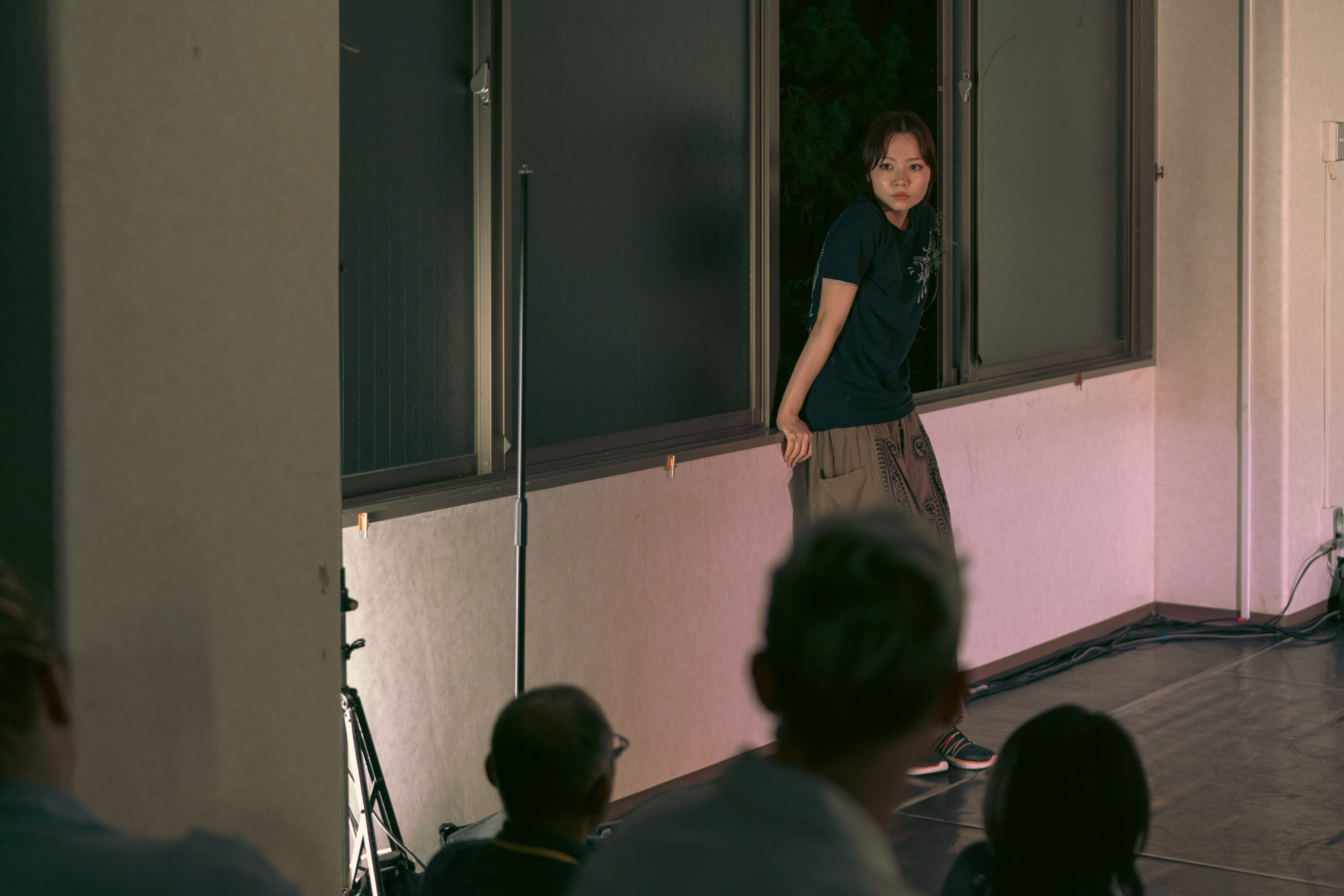
Photo by Ryo Yoshimi
The following review was selected for publication as part of the Performing Arts Criticism Project 2025.
Production Information
Takuya Murakawa “Tennis (stage version)”
Performed: October 9-13, 2025
Confession and Mistery
Of all the people we meet in our lifetime, we do not get to build deep relationship, getting to know their half a lifetime, with every one of them. But in this work, we witness the three performers’ inner-selves and the “confession” about their lives. Thus, in the encounter with those three performers, there is somehow a sense of something destined.
The venue of this work, Sakyo East Area Iki-iki Citizen Activity Centre, is approximately 15-minute walk from Kyoto Municipal Subway’s Keage Station. Many of people involved in performing arts in Kyoto and the Kansai region, including myself, probably agree to the understanding that this venue, which appears at first sight like a school building, is just another rehearsal space. There is no explanation given as to why the maker of this work has chosen a meeting room in this building, a space in the periphery which, I am sorry to say this, cannot be thought of as a venue of main programme in an international arts festival, having none of flamboyant atmosphere.(1) It is the first time that this building is used as Kyoto Experiment’s venue. But, in its selection of the space, this performance questions our unconscious preconception about an international arts festival, that this kind of programme should be presented in a more respectable place.
Before getting to an experiment which I think is the reason for this selection of place, let’s follow the performance structure of this work.
This work consists of mainly three scenes, and they each focus on one person, with the pre-recorded interview of that person played in the background. And, because the interview recordings are played like the “off-screen” sounds of film or video works (this is the same in the original documentary film), it feels like they have no relation with their actions on stage.
In the first scene, three young men appear and the interview with one of them is being played throughout the scene, while they play tennis in the temporary tennis court set up in the meeting room, sometimes taking breaks. In the interview, he talks about his upbringing, born between a Japanese mother and an Indonesian father, about living in Japan as a muslim, how he became conscious about his identity as a “half”, and how he is now proud of being different from others rather than feeling inferior, about starting to do the prayer that muslims do regularly because he wanted to play video games which was banned by his parents etc.. And, like in the original film, there is also time when the man silently conducts the prayer in the corner of the stage. Partly because of this man’s personality, the interview as a whole gives a cheerful impression. Even though individual topics mentioned in the interview, such as the difficulty with multicultural symbiosis, and discriminative nature associated with the word “half”, are something that are taken up negatively in newspaper, magazines and social media, what we can sense from this interview is something different, the presence of individuals’ everyday life.
In the second scene, after the men exit and the net is removed, one woman appears in an empty space drifting around and, with this in the background, her interview continues to play. What she says in the interview, including her complex identity – a Japanese mainlander having an Irish blood and has an Okinawan identity as the result of being raised in Okinawa and now lives in the mainland, her experience of people around her in the mainland being “kinder than expected” but hurt by their ignorance about Okinawa’s “Memorial Day”, are mostly based on how she felt towards the differences between Okinawa and the mainland. During this scene, she does things by herself in an unstructured way, without playing tennis. She collects tennis balls scattered on the floor and rolls them one at time to the audience in the first row saying “here we go” and ask them to return it to her, doing this repeatedly, she shakes hand with the cooperating audience members, then switches off speakers at the back of the stage playing the interview, opens a window of the meeting room (!), feeling the wind coming in while glancing at the audience, draws something abstract, and so on.
Compared with the first scene, in which there was a net just as the fourth wall between the stage and the auditorium and the performers were playing tennis without acknowledging the presence of the audience, there is a clear difference in this scene that the fourth wall is physically removed and the character who is clearly conscious of the audience’s presence is directly engaging with the audience by handing and receiving tennis balls, shaking hands, and opening the window to let the outside air into the room. And the place itself has changed its character. The act of turning off speakers and opening the window suggests that the place is just a meeting room in reality, but, with tennis balls on the floor, the place also bears the remains of temporary tennis court set up in the first scene. Then, now, the place is neither the supposed-to-be tennis court nor a meeting room of Sakyo East Area Iki-iki Citizen Activity Centre, but it appears in front of us a layer of the place where the two overlap and mix.
In the third scene, after the woman has gone, the place returns to the tennis court again. Three men who appeared in the first scene are back and start to play tennis, and another woman who was seen briefly in the previous two scenes appears and her interview is now played. This woman does not play tennis herself and seems to be someone cheerfully looking after tennis club, giving instructions to the three men, but it is revealed in the interview that this woman has been fighting in her life with various illnesses. There was a hole in the heart valve and had a surgery, it seemed she had a genetic disorder, an episode of letters sent from her classmates when she was in hospital for long time, that she cannot do any exercise that involves heavy breathing, about her father’s tears when her emotion exploded after repeated illness, and so on. She plays her keyboard harmonica that she has brought with her, as if to check and feel the keys one by one, to take breath one by one; it may be because we feel like we know her life, even a part of it, that the depth in each of simple keys touches our hearts.
Unless becoming psychics, we cannot know what kind of life the people we meet for the first time have gone through. Also, we can never know what our family or friends really have in their minds, including their thoughts and beliefs, even if they are by our side. But, as we have seen hitherto, the feeling we get from the private “confessions” in the recorded interviews of this work, which are full of intimacy, gives the impression that maybe that is possible. Voices from “off-screen” interviews, which are not spoken now or here, become their hidden “inner-selves”, and the disconnectedness of their actions on stage strengthen the impression that the voices reflect the “inner-selves”. We feel like we know or understand their true selves (if ever such things exist) that never appear on the surface. We are being confessed to. (2)
In that moment, the audience witness an inseparable relation between the voice of “confession”, which makes the person bear the burden of a certain attribute or identity and, as if, the “inner-self”, and the body taking actions which apparently are unrelated. The words spoken in those three interviews, even though “the personal is political,” can be thought as the private “confession” of small voices, rather than the words of the “public”, because of what are said in the “confessions”, they become the tags to give those three performers certain attributes or identities, such as a muslim with a Japanese and an Indonesian parent, a mainlander with an Irish blood who grew up in Okinawa, or a woman who has been fighting with multiple illness. When listening to their confessions, it may be that the audience cannot help recalling recent issues of discrimination against foreigners, long history of complex relationship between the mainland and Okinawa, and other big problems. That prompts us to capture their presence within the framework of certain attributes, identities or big issues, and prevents us from seeing them as they are. Yet, at the same time, let us go back to the second scene in which, as already mentioned, there was an existence escaping from such framework and appearing in front of us. There, what is also deeply related is the layer of that place, which is neither the supposed-to-be tennis court nor a meeting room of Sakyo East Area Iki-iki Citizen Activity Centre. I am tempted to call this layer of the place, the beginning of “space of appearance” defined by Hannah Arendt as public space.
Arendt discusses the distinction between “what” and “who” in relation to identity, defining “what” as inert-changeable identity including social positions and attributes, and “who” as a form of identity needing the presence of the other, which is constructed by the responses of the other to actions or words. And, as opposed to the “space of representation” where representations are dominant and everyone is treating each other as “what”, the “space of appearance” is created where people relate to each other through actions and discourse, a space where the other appear as “who” when the expectations towards the appearing other are denied, also a theatrical space (!) where there is a hope for the unexpected. Indeed, the woman in the second scene appears present in front of the audience as “who”, trying to escape from “what”, certain attributes, identities or big issues, by relating to the audience unexpectedly and directly, throwing and receiving tennis balls, shaking hands, turning off speakers, opening the window to let the air in and acknowledging the audience, and lastly throwing questions randomly at the audience and anyone. She does not go as far as to cross the boundary between the stage and the auditorium to relate to each other, but the audience are led to the beginning of the “space of appearance” where people relate to each other purely by responding to actions and words.
Thus, the place where private confessions occur becomes the “space of appearance”, in other words, a public space. What we are then made to realise is a fact that the place, Sakyo East Area Iki-iki Citizen Activity Centre, through various activities, is a respectable place which functions locally to play the public role, and that, at the same time, while maintaining that local public responsibility, it can be connected to the global by providing a performance venue for an international performing arts festival like Kyoto Experiment. This way, it may be argued that this work, with its contents and the selection of the venue, becomes one of the practices that gradually bridge the private and the public, the local and the global.
Through this work, maybe we have come to know a little bit about the three performers’ inner-selves and their lives. However, this does not include two of three men who were playing tennis in the first scene. Their interviews are never played in this work. We do not have a chance to know whether they could not speak, or they did not have anything to speak about, or they were not allowed to speak, or if there is any other reason. This performance ends as one of those two men continues to silently swing-practise tennis racket, after everyone else is gone, with the lights slowly fading out. Those two men remain as mystery. But, to think back, if we could never know even what our family and friends who are by our side really have in their minds, then maybe it is normal that they are “mystery”. Due to the fact of avoiding the confession, we in the auditorium are on the same side as those two men. In reality, we never hear that kind of interviews. Therefore, for each of us, most people in the world are mysterious figures like those two men, and vice versa. And, that is why witnessing the confessions of inner-selves and lives of the three performers, whom most of us meet for the first time, is somehow similar to the feeling of a destined encounter.
(1)
Although I did not get to see it, there was a 30-minute-long trial performance of this work at the same venue last year as part of C.T.T. Kyoto program. It seems reasonable to conduct the final presentation at the same venue as the trial performance.
https://cttkyoto.jugem.jp/?eid=164#sequel
(Website written only in Japanese.)
(2)
Regarding how the voices of interviews that can be perceived as “confessions” sound like reflecting their “inner-selves”, please refer to the following remarks from Origins of Modern Japanese Literature by Kojin Karatani (Kodansha, 1988).
“Confession as a form, or confession as a system, has produced the inner-self to be confessed, or something called “true self”. (…) Confession is made not because there is something to hide. An obligation to confess has created things to conceal, or the “inner-self”.”
*Quotation translated into English by the translator of this review.
(3)
Sakyo East Area Iki-iki Citizen Activity Centre note
https://note.com/sakyo_east
(Website written only in Japanese.)
—
Reference
Saito, Junichi (2000) Publicness (Frontier of Thought), Iwanami Shoten
*Book title translated into English by the translator of this review.
Author Profile
Keiji Mitamura
Lives in City of Osaka. Conducts various activities related to theater mainly in the Kansai region. Awarded the 18th Kansai Contemporary Theater Actor’s Prize. While labouring and child-caring, performs in theater if there is time, and writes some texts and theater reviews.