Performing Arts Criticism Project 2025 Selected Reviews: Shoko Miyaguchi
2025.12.24 (Wed)
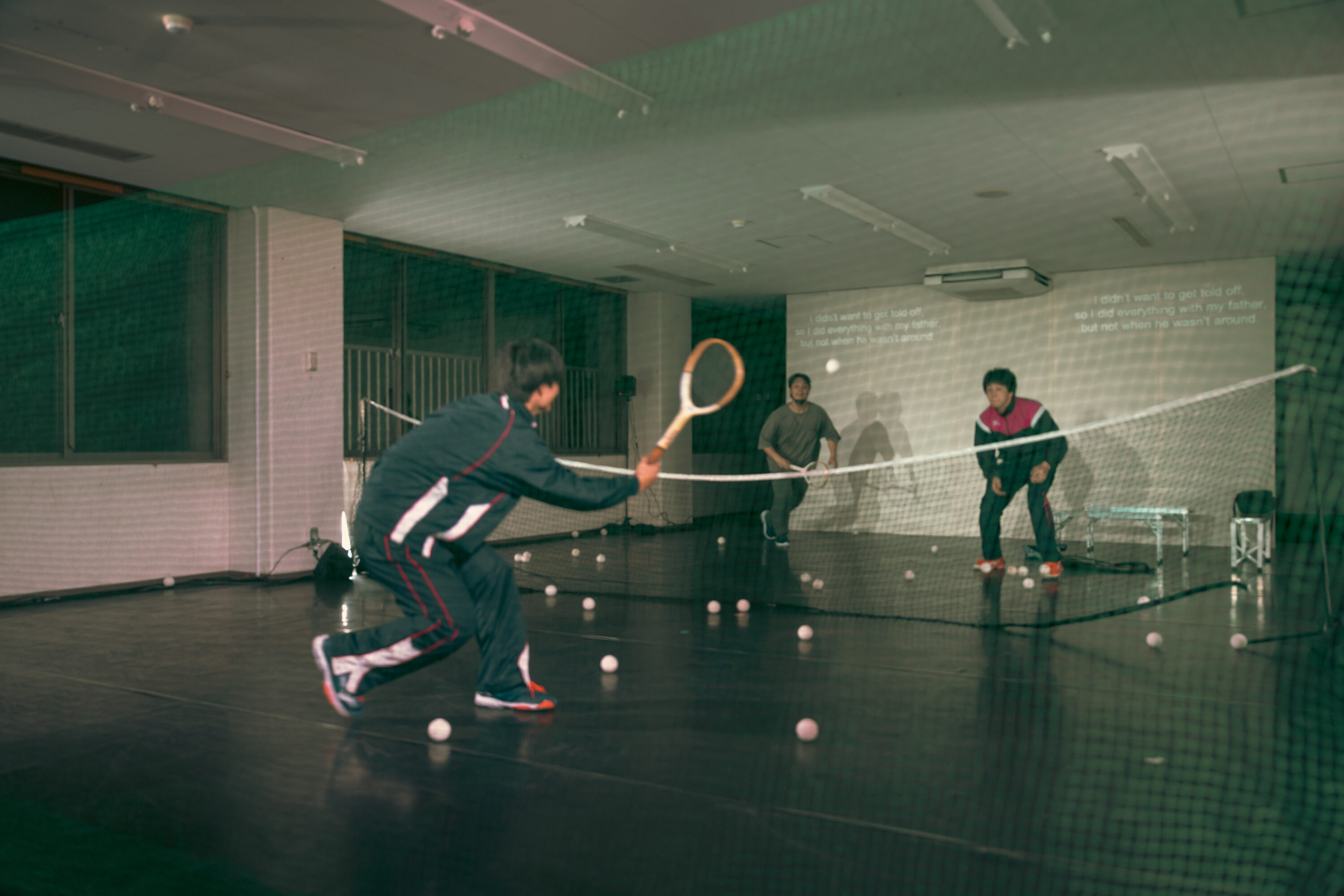
Photo by Ryo Yoshimi
The following review was selected for publication as part of the Performing Arts Criticism Project 2025.
Production Information
Takuya Murakawa “Tennis (stage version)”
Performed: October 9-13, 2025
What We Saw Beyond the Fictitious and the Real
It was a stage performance that went back and forth between the world of fiction and the reality.
A net was put up in front of the audience and the scene of tennis suddenly started. It almost appeared slapstick at the beginning but, in-between the play of tennis, we hear the personal history of one of young men playing tennis through the recorded interview. As we saw tennis played live, we listened to the voice of a young man and followed the letters projected on the wall.
We were supposed to be watching from somewhere continuous from the stage and immersed in it but, gradually, tennis turns into a background scenery and, strangely, the words of the young man sounded more like whispers coming directly to the ear. His monologue was serious, different and unknown.
When the monologue of the young man finished, I was going to clap my hands and then stopped. For just a second, like me, there were few other audience members deciding whether to clap their hands or not. Maybe we could do so because it was clearly an end of one single scene. But was the young man wanting the applause from the audience towards his monologue? I was staring at his face with confusion.
Personal histories of the characters reached our ears amidst the world of fiction on the stage. Are they part of the fictitious theater or are they real confessions? As I was feeling shocked by the personal histories of the three young people, because there was an ambiguity as to where the line between the fiction and the reality was drawn, I was being hesitant to clap my hands. Through their stories, I saw the glimpse of the world I had not known: the difference the children with foreign background would feel between them and the “Japanese”, the way they confront with the religion their parents believe in, the gap between Okinawa and the mainland, a unique spiritual world of Okinawa, experiences of serious illness and disability. The heftiness of those stories questioned me whether I should clap or not. And that also stopped many of the audience members from clapping and, as the result, created a silent “pause” on the stage.
If there were more audience members who saw this scene as part of theater, I think there were some applauses. It was a kind of scene that could go either way. Because of this contingent and accidental nature, there was a moment when the audience who stopped clapping turned into something like a lump of consolidated air. I was wondering what was going through the young man’s emotion, being press silently by the audience, as well as having spoken about his own upbringing. As I watched on the first day in the run of the performances, maybe both the audience and the performers were still trying to figure out. Maybe it was not conveyed to those who were performing, but we were feeling tense as we watched silently.
Because the original work of this performance was by a student film director, I had the impression that the performers were chosen from the friends of the film director and the members of university tennis club. The performance seemed to emphasise the characters who stood close to everyday life, as a very local Citizen Activity Centre was chosen to be the venue. But, in real life, there is no situation in which university students would talk about their personal history as they play tennis. While having a strong emphasis on the ordinariness, the performance had young people standing on the stage of fictional theater, and took the unique form of playing their personal histories through recorded voice.
If this was a monologue in solo performance by a trained actor, even though the quality of the work may improve, it would become over-dramatic and lose the sense of reality. On the other hand, if they speak their personal histories being interviewed in front of the audience, it would be too heavy and the audience cannot relax to feel empathetic. For this performance, theatrical elements are essential and, by using such elements, the audience could accept naturally their complex personal histories.
As the everyday act of playing tennis is both appearing on the surface of the stage and also becoming a background scenery at the same time, their personal histories emerge. Time that is continuing from the past, the present and to the future. In that space, we encounter their personal histories unexpectedly and could take them into our world. Because of this unexpectedness in theatrical direction, rather than it being one-directional, it slipped into our minds naturally. And by putting multiple layers of time that span in each of their lives on to the time of playing tennis, there arises a well-balanced intersection of the lightness of everyday life and the heftiness of personal life. Has this been all planned or is it somehow accidental?
Moreover, people who gather at the tennis court are not all the same; some play tennis, and some do not. Even though they seem like being close to each other, there are things that they don’t know about others, and they do not step too much into others’ life; they spend their life in a rather detached manner, having unchangeable solitude and something destined. The covered world of young people are individually captured from a bird’s eye point of view. And the atmosphere becomes more tense as the monologues of three people are played in turn. There is a sense of having no place to escape to as things camouflaged seem to emerge and come close to us from the far.
We were listening to their words indirectly, yet gradually they started to sound like being released straight from their bodies. And it was like having them sink into my own body during the time I was watching the performance. Then, through their speeches, the world that was supposed to be unseen start to become visible. It is the world that we thought we knew but we actually did not. It is the world we had not stepped into. We were reminded again that the world in front of us was a limited view seen through one’s own filter.
The audience could smoothly immerse themselves into their speeches alongside the practice of tennis, not only because of theatrical effects, but also because the audience themselves had the base to accept this setting. It was easier for us to listen to their voices indirectly, instead of hearing them straight from them. That resembles working as we listen to radio or music, or finding some moments of silence and focus on something in the congested place. Or, just as everyone is looking at their smartphones in the train, we are used to separating ourselves from the stream of time that runs in front of us and staying in our own world.
Although confused at the beginning by the combination of playing tennis and the speeches of their personal histories, we were able to take them in smoothly, because, without interrupting the scenes of tennis, we could catch the voices as if hearing them through the earphones and follow the letters as if watching the mobile screen, taking them all into our own world.
On the surface, it seems like we were thinking about those young people and that the distance with others was shortened, but, in fact, I was made to realise that there was an even wider division with others. Even during the performance, once I started thinking about them, I sank into my own world, and then brought back suddenly to the scene in front of me on the stage. This was repeated again and again. During the performance time, my time inside me was running too. Even though I was shocked by their monologues, the information was new to me, and I was full of curiosity. That attitude can hardly be described as an empathy. “The contours of the near-yet-far distance between self and other.” This performance reminded us of that sense of distance, which we are not normally aware of, by having some glimpse into others’ lives. As immersed into the screen of smartphones while being in this world, we go back and forth between the reality and the fictitious world in our daily life, more often than we think. Society and individuals, the other and the self, while being at the same place, we are drawn into the world of the virtual, half-awake and half-asleep, finding some comfort there. Through this work, which brought to light the lives of young people as a group in the setting of tennis court, we were exposed to this habit that we have obtained, and also to the fact that the division with others has started to poison us, which felt dreadful.
Truths are varied in the reality, and no one wishes to start talking about them. We could only gain an understanding in the fiction. It was time accompanied with pain, but the view we saw was something we could only see because we got close to the reality through the theatrical fiction and transcended it.
Author Profile
Shoko Miyaguchi
Born in 1961 in Kyoto City. Graduate from College of Social Sciences, Ritsumeikan University. Worked as a copywriter, then moved to Kishiwada City after marriage. Now, teaches cooking and craftwork at the local community centre and opens a café twice a month in Misaki Town, located in the most southern part of Osaka. She looks forward to Kyoto Experiment every year, which enables her to see the world that cannot be experienced in everyday life.