Performing Arts Criticism Project 2025 Selected Reviews: Zhang Yiyi
2025.12.24 (Wed)
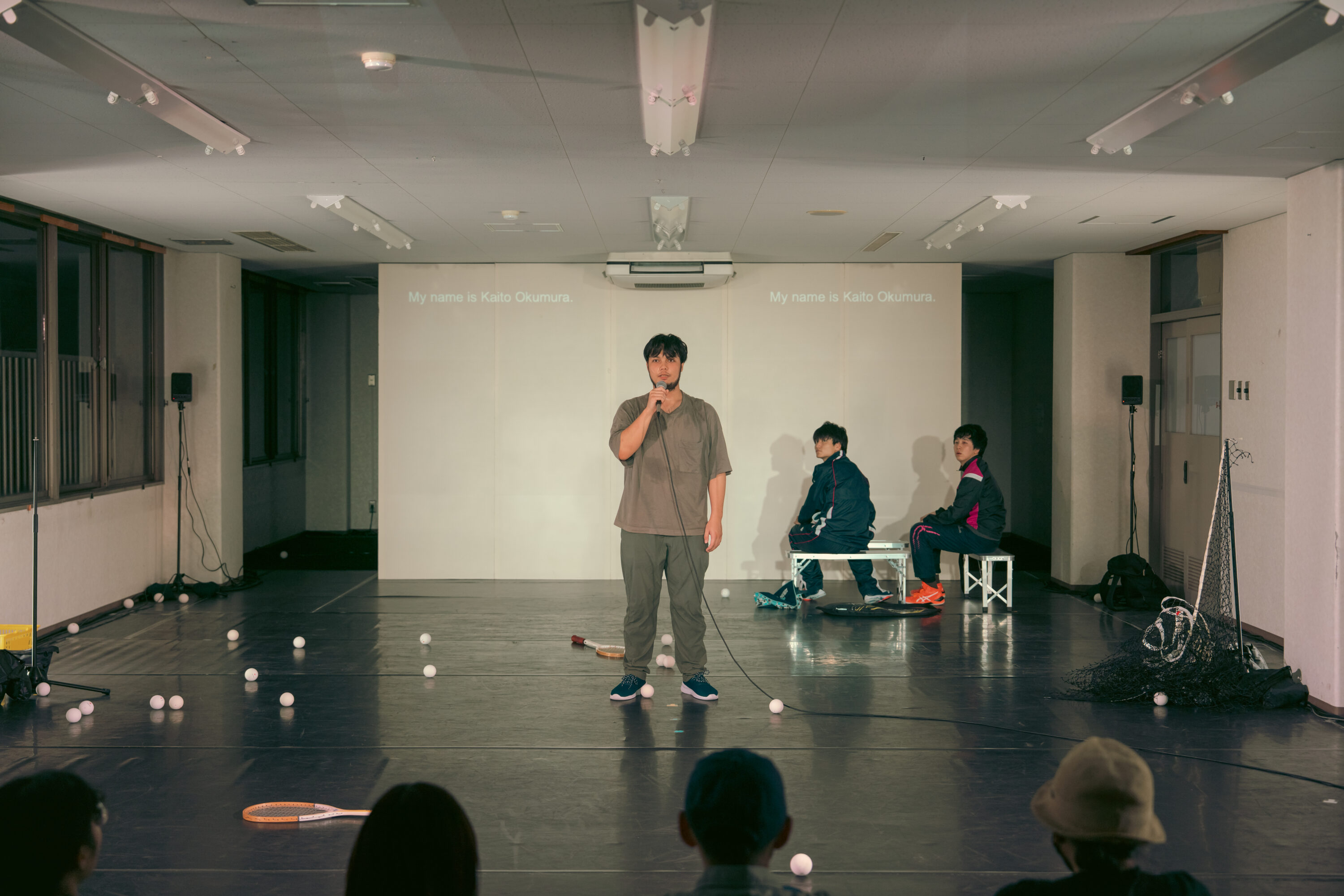
Photo by Ryo Yoshimi
The following review was selected for publication as part of the Performing Arts Criticism Project 2025.
Production Information
Takuya Murakawa “Tennis (stage version)”
Performed: October 9-13, 2025
In-between the Voice and the Body: The Distance From the Audience Towards Those Directly Concerned Identified by Takuya Murakawa’s Tennis (stage version)
Why are you here? I was being questioned as I was watching this performance.
The performers stand on the stage which is meant to be a tennis court. For sure, their bodies are present “here, now”. But they do not speak. Their speech about the prayer, Okinawa and illness are heard through recordings from speakers. Only at the end of each three parts, in which the three performers are featured respectively, do they speak to tell their names.
“My name is Kaito Okumura.” “It was SOLA speaking.” “I am Kaho.”
They echo in the space, not as recordings but as real voices. As if to cut through the foregone speeches heard through speakers, the voices appear “here and now”. We had been meaning to hear their voices and to see their bodies. But their self-introductions indicate that what we had been seeing were not “themselves”. There was an unbridgeable distance between the recorded voices and the bodies in front of us. And, that distance is the core of this work.
Tennis (stage version) by Takuya Murakawa, presented as part of Kyoto Experiment 2025, inherits the methods of documentary theatre which have those who are directly concerned being on stage, yet at the same radically questions the very structure of such methodology. As I watched the performance being a foreign woman living in Japan, I did not feel the uncomfortableness that I have felt with many other documentary theatre works. The minority talks about the “hardship” on stage and invites the audience to consume it with tears; the feeling of discomfort that come with such a structure of performance was hardly seen in this work. This review will examine how the structure of this performance which involves the separation of the voice and the body, starting from the very moment of self-introduction by the performers, succeeds in establishing an ethical practice that “does not engage in any typification of those who are directly concerned”.
The venue of this performance is a meeting room at Kyoto City Sakyo East Area Iki-Iki Citizen Activity Centre. It is a place of daily life where people gather to have community meetings and exercise class for the elderly takes place. The performance consists of three parts and three performers, Kaito Okumura who talks about the prayer as a Muslim, SOLA who grew up in Okinawa with the roaring sound of the base, and Kaho who has congenital heart disease, appear in turn. Their “speeches” are pre-recorded and being played from speakers, while their bodies are engaged in different actions such as playing tennis or playing with balls. The performance continues as the voice and the body are separated and, only at the end of each part, they introduce themselves with their real voices.
In usual documentary theatres, the minority performers are forced to engage in the labour of explaining about their wounds each time they perform, and to fix themselves to certain symbols such as “the disabled” or “the victim”. Murakawa avoids this fixation by having the voice and the body separated. Once I saw a performance in which the audience were in tears seeing the performer talk about the experience of discrimination. The audience were only affirming themselves as being good people by watching “victimised people”. And, for those tears, how many times does the performer have to open the wounds? I felt irritated.
In Murakawa’s Tennis (stage version), there is no such a structure that is characteristic of documentary theatre. There are performers on stage and their bodies are present “now and here”. But their voices are heard from speakers as recordings. This temporal distance functions as the first protection. Recording makes it possible to edit the speech and the performers can have the control over what is being said. Even though they are exposed to the gaze of the majority, they are not forced to “speak now and here”. It is also important that the contents of the speech and the body actions do not coincide. While Okumura’s voice talks about “the prayer”, his body on stage is playing tennis. It is also the case with other two performers and their bodies continue to do things unrelated to their speeches. This mismatch is the second protection. Their bodies do not represent “Muslim” or “victim in Okinawa” or “child with sickness”, but they are there as bodies playing tennis. This neutral action emancipates them from stereotypes. For example, in the first part of the performance, the audience watch Okumura playing tennis on stage, while listening to his speech about the prayer played from speakers. We try to connect those two things, but we fail. And the difficulty in making the connection questions the audience; Do I really “understand” Okumura or am I just seeing the “image of Okumura” that I have made up? This structure forms a dramaturgy that does not engage in the typification of those who are directly concerned with the issues.
What Murakawa chose as the contents of their speeches are also crucial. The speeches of the three performers tell, not “touching stories of overcoming difficulties”, but their desire in everyday life or experiences filled with accidents and ambiguity. Okumura’s story about “praying for video games” is not that of “deepening one’s devout religious belief” which the majority expect. When he was a junior-high school student, he prayed to get his computer game back. But he says; “It was an experience of my wish coming true. Then I started doing it on my own will.” Through his desire to play video games, Okumura has made the prayer “his own”. It was not the “correct belief” that his father intended, but he gained his cultural agency unexpectedly from a misapplication and coincidence. SOLA tells us, even though “there is no Okinawa blood in me,” what shaped her as a person are things like “drumming sounds of Shimadaiko, summer breeze or the sound of waves.” There is a narrative that essentially seems to overcome the principle of bloodline. One’s identity is not determined by blood or essence, but gained though physical and sensory encounters. Yet, this is not insisted loudly, but it appears naturally as she calmly talks about her experience. Kaho spent time in the hospital when she was at primary school in order to have heart surgery. Letters from her classmates did not have words of encouragement but were filled with the episodes of their teacher’s honeymoon trip. There is a lack of “touching experience” that is largely expected, but instead a kind of “idiotically optimistic attitude” that does not treat a sick child as an exception.
It was due to this structure that I did not feel any antipathy towards this work. In many performances of documentary theatre, the “hardship” of the minority is arranged and processed to be something that the majority can easily consume. But Murakawa presents the complexity of experience and contradictions as they are. A boy who prays for video games, a sense of belonging to the place without any blood relation, and the gratitude towards people around with idiotically optimistic attitude. Because they refuse to be contained in “touching experience” and maintain the complexity of such experiences, I could watch the performance without any discomfort.
At the end of each part, the performers tell the audience their names with their voice. Up to that point, they had been the “objects of speech”, they were being talked about, but, just for a moment when they say their names, they appear as the “subject of speech”. The utterance of “my name is Kaito Okumura” is not just a self-introduction. It is the moment when “the quoted other” who were pushed to the periphery without names become “the other with real presence” by introducing themselves. It is a confirmation that “I am the subject of the speech you have been listening to” and at the same time a declaration that “I am present here having transcended my speech”. The speech is part of oneself but not the whole.
“Mabui-gumi (restoring one’s spirit)” that appears in SOLA’s speech is a key to understanding Murakawa’s dramaturgy. SOLA fell off from a big banyan tree when she was a child and adults conducted the Okinawan ceremony. They stroked her back as they recited “mabui, mabui, come back”. Mabui means spirit and this was the ceremony to bring back the spirit that had left her body because of the shock. SOLA recalls; “By some chance, I could suddenly move and speak again.” What is decisively crucial is that there is an uncertainty in whether the ceremony would succeed. The expression “by some chance” acknowledges the ambiguity of cause and effect. What is important is not the result, but the act of calling itself. And this is Murakawa’s dramaturgy. The body on stage is present, but it “does not speak” and is in the spiritless state. The recorded speeches are being heard, but the bodies that uttered the speeches are “somewhere in the past”. And we, the audience, try to connect the two, in other words, we are the ones who try to conduct the mabui-gumi ceremony. But this making-connection is merely a manipulation that we do on our side. We may be just connecting them randomly.
The structure of mabui-gumi overlaps with issue of “understanding” in multicultural society. We tend to think that we understand the other’s speech though our own framework. But a complete understanding is impossible. What we hear is always the “speech of the past” and we cannot “live” the body of the other. When the majority think they “understand” the minority, that understanding is often a projection, in other words a manipulation of the other’s speech to affirm one’s own goodness, having read the “touching story of overcoming”.
But, instead of giving up, to keep facing the other even though recognising the impossibility of understanding the other completely. To keep calling, even in a difficult situation where one cannot definitely say “I understand”. The ceremony of mabui-gumi is the symbol of such attitudes. The calling is not just to shorten the distance with the other but is a necessary act for preventing us from running away to an easy “we think we understand” state. To keep calling is to keep taking on the uncertainty of understanding and is an ethical attitude of maintaining a tense relationship with the other. Murakawa’s dramaturgy demands the audience to “keep calling” and to “recognise the uncertainty of such an act”.
There may arise a question whether the one who calls structurally stands on a superior position. In this work, what is important is that whether to respond to the calling is entrusted to the performers. The act of self-introduction is not something that the audience have “pulled out”, but it is an active response by the performers. In mabui-gumi, too, the spirit is not forced to come back, but it does so by its own will. Self-introduction is the very moment when the spirit has come back with its own will. But it is still not certain whether it means that the “understanding” can be achieved.
By rolling the ball over to the auditorium in the second part, the separation of the voice and the body, and the structure of mabui-gumi are connected to everyday life. In the first part, the performers hit the balls and, then, put down rackets and started throwing balls with their hands. Yet, even if they throw the balls with their hands, there is still something that mediates in-between. When we relate to the other, it is always mediated by something. The tennis court net that was put up between the stage and the auditorium has been removed at the end of the first part. Then, balls are rolled over towards the auditorium. The audience are asked to respond. To pick it up, or to ignore it. The ball becomes the symbol of intercultural calling. In our everyday life, we, too, throw balls, namely words and actions, at the other. It is always uncertain whether the balls reach the other or not, and how they will be received.
However, there is an absolute asymmetry. The audience will go back to their everyday life once the performance is finished, and the experience on stage will be completed as an “event in theatre”. But the performers continue to live with the reality that is in the background of what have been said in their speeches on stage. Okumura as a Muslim, SOLA as someone who grew up in Okinawa and Kaho as someone with heart disease, they will keep being exposed to the difficulties accompanied with their reality. Murakawa does not hide this asymmetry and makes the audience realise by throwing the ball. And this is where the meaning of this work having been performed at Citizen Activity Centre lies in. The question exists in our daily life, outside of the celebration called arts festival.
The question that emerged from the moment of self-introduction is unfolded throughout the dramaturgy of Tennis. This work has succeeded in practising “not putting those directly concerned with the issues in typification” by having a structure in which there is a separation of the voice and the body. Through a temporal separation (recording), spatial separation (mismatch of the action and the speech) and the selection of stories that can maintain the complexity, the performers are not fixed as the “objects of the speech”. With the structure of mabui-gumi, the audience attempt to make a connection, but whether this succeeds or not is uncertain. Even if the spirit is restored temporarily through self-introduction, this does not mean that the calling by the audience has “succeeded”. It is up to the performers to decide whether to respond. To take on the possibility of failure in calling, and to make the failure visible, are the ways to resist the violence of sympathy or echoing the emotion that can come easily.
There may not be a complete understanding or perfect equality. But the “unbridgeable distance” that I felt at the beginning is not a division for hopelessness. It is an essential space for us, not to escape to an easy understanding, but to keep calling the other in front of us.
Though we live in a time when the word “multicultural symbiosis” frequently appear in policy documents, can we really “be present together”? Murakawa’s Tennis (stage version), with the impossibility of understanding, still questions the meaning of keeping the calling. The live self-introduction of the three performers return the question back to us. Have we really encountered them? The ball has been thrown. The response is tested in our everyday lives.
Author Profile
Zhang Yiyi
Graduated from the Department of Body Expression and Cinematic Arts, Rikkyo University, currently taking the Doctor’s Course at the Department of Arts Studies and Curatorial Practices, Graduate School of Global Arts, Tokyo University of the Arts. She values dialogue and collaboration with people who have diverse cultural backgrounds, including immigrants, people with disabilities and sexual minorities. While working both in the practical field and in academic research, she is searching for a theatrical approach to realise “multicultural symbiosis”. In 2024, she has written and presented her master’s thesis based on a multilingual theatre piece The WORLD, which was created with multicultural collaboration and which she was in charge of planning and structural design . In 2025, she was selected to be part of Tokyo Metropolitan Theatre’s “Tokyo Borderless Theatre Project”, creating and presenting a work-in-progress piece. She was a participant of Arts Council Tokyo’s FY2025 Overseas Study Visit Program for Arts Management Professionals to go to Edinburgh.