[Article] The Stone Thief: Haneko Takayama
2026.9.19 (Sat)
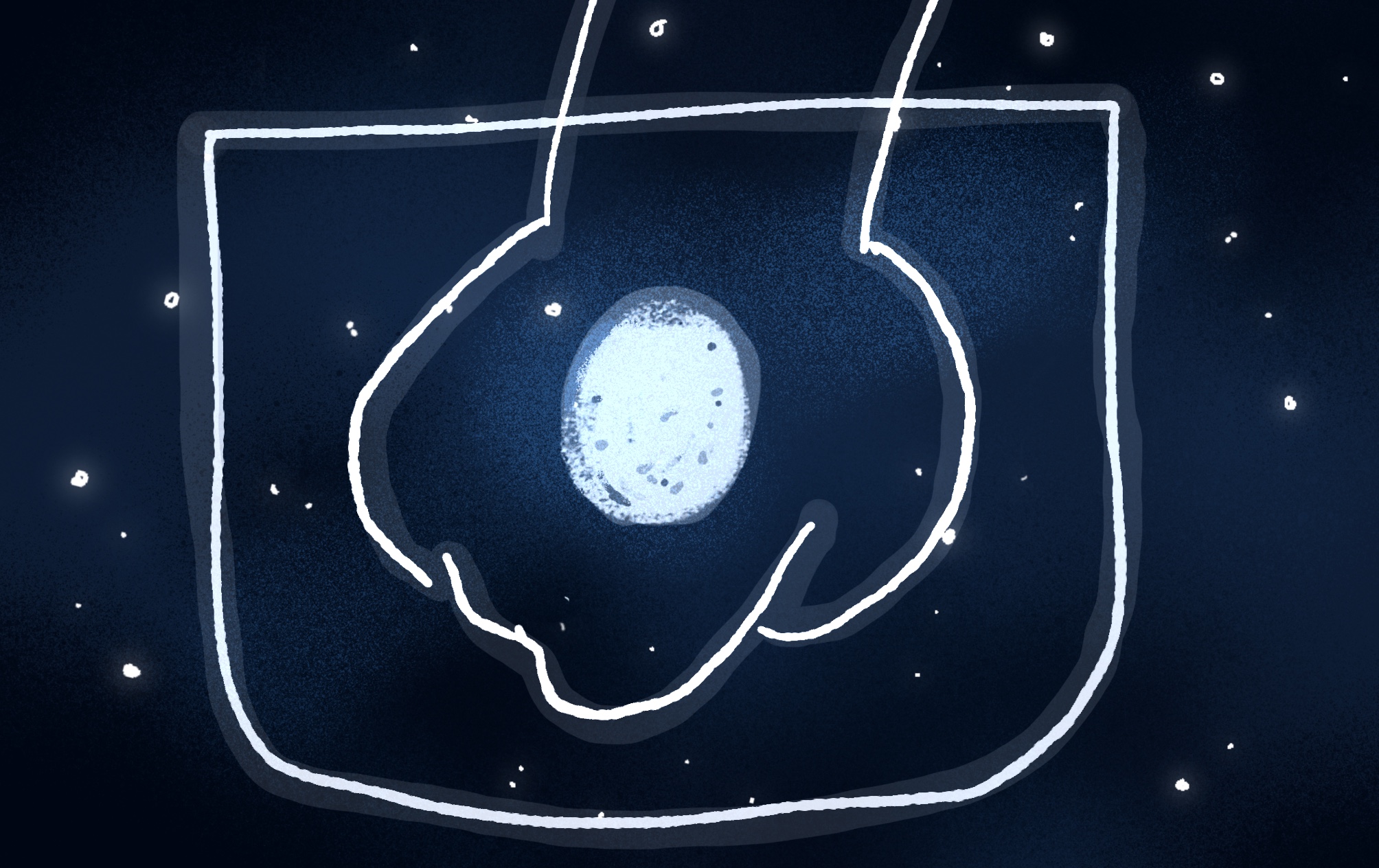
Illustration by Robin Agemi
He that is without sin among you, let him be the first to cast a stone at her.
This is a very famous phrase, so much so that it is frequently quoted by people with no inkling of its biblical origins—from the Gospel of John (8:7), to be exact. A spotless ladybug was once crawling along the window frame in my classroom. This is a memory from my time at a school I attended after passing the entrance exam, and where the custom was for a pastor to read a passage from the Bible and for everyone to sing hymns at the start of the week.
It is said that stone was the first human tool. We have examples of stone tools believed used by the extinct archaic human species Homo habilis (literally, “handy man”) some 2 million years ago. It was recently learned that Australopithecus africanus, an even older species from over 3 million years ago, also used rudimentary stone tools, a discovery that came not from finding actual worked stones from that era, but from studying the skeletal structures of early hominids. This is because bones change physically when subjected regularly to the strain of gripping objects and performing intricate manual tasks like shelling nuts while foraging or butchering a catch after a hunt. By comparing these skeletal changes with the bones of hominids predating tool use, we can infer the kinds of daily activities the species did. In a museum gallery otherwise devoid of people, I look at a display of archaic humans apparently reconstructed from their skeletons, and it occurs to me that no one can say for sure whether these exhibits are truly accurate, much less the dioramas showing how the hominids supposedly lived their lives.
As I move further into the gallery, I come across a piece of rock brought back from outer space. Inside a glass display case is a capsule made of resin or some such material, and containing a rock about the size of a fingertip. Are these strict measures intended to protect against crime (that is, to keep the rock out of reach) ? Or conversely, to protect visitors from the rock’s toxicity? It is unclear. The rock is an aggregate of minerals that has drifted in an environment where humans cannot survive unaided, so that its constituent parts might cause harm is a very real possibility. After all, not every substance in the world facilitates human survival; even the very first tools humans created were likely weapons for inflicting injury. In fact, it was once determined that Apollo program scientists had been contaminated by lunar dust. If a warning or some kind of measuring instrument were placed next to the exhibit, perhaps no one would attempt to steal it, though lunar rock thefts have occurred around the world.
Leaving the museum, I walk along the path of the courtyard toward the exit. What makes the gravel around the fountain different from the space rock displayed inside, I wonder. I crouch down and pick up a piece of gravel. Sure enough, it too has a coating of countless microscopic particles. Almost all are harmless to humans, though a tiny fraction could be dangerous. Should a stone simply find its own way into my shoe unnoticed, none would cry foul, but for me to actively slip one into my pocket would likely cross a clear moral line. And then to take that stone to a nature reserve in another country, let alone another planet, could result in serious contamination.
Presuming there is anyone who truly believes they have never done wrong in their life, even such a person would surely not cast stones at others. This is the thought that occurs to me in that moment. But now, I find myself reflecting on the sinfulness inherent in the act of holding a stone in my hand.
Author Profile
Haneko Takayama
Born in 1975 in Toyama Prefecture, Haneko Takayama is a Japanese novelist and science fiction writer. She studied painting at Tama Art University. She won the inaugural Sogen SF Short Story Prize for “UDON: Unknown Dog of Nobody,” the second Fumiko Hayashi Literary Prize for her story “The Island on the Side of the Sun,” and the 163rd Akutagawa Prize for the novel A Horse from Shuri. Her other published novels include Come Gather Round, People, Objectum/Impostor, Lenses in the Dark, and Panda Pacifica.