[Interview] Nhã Thuyên
2026.10.15 (Thu)
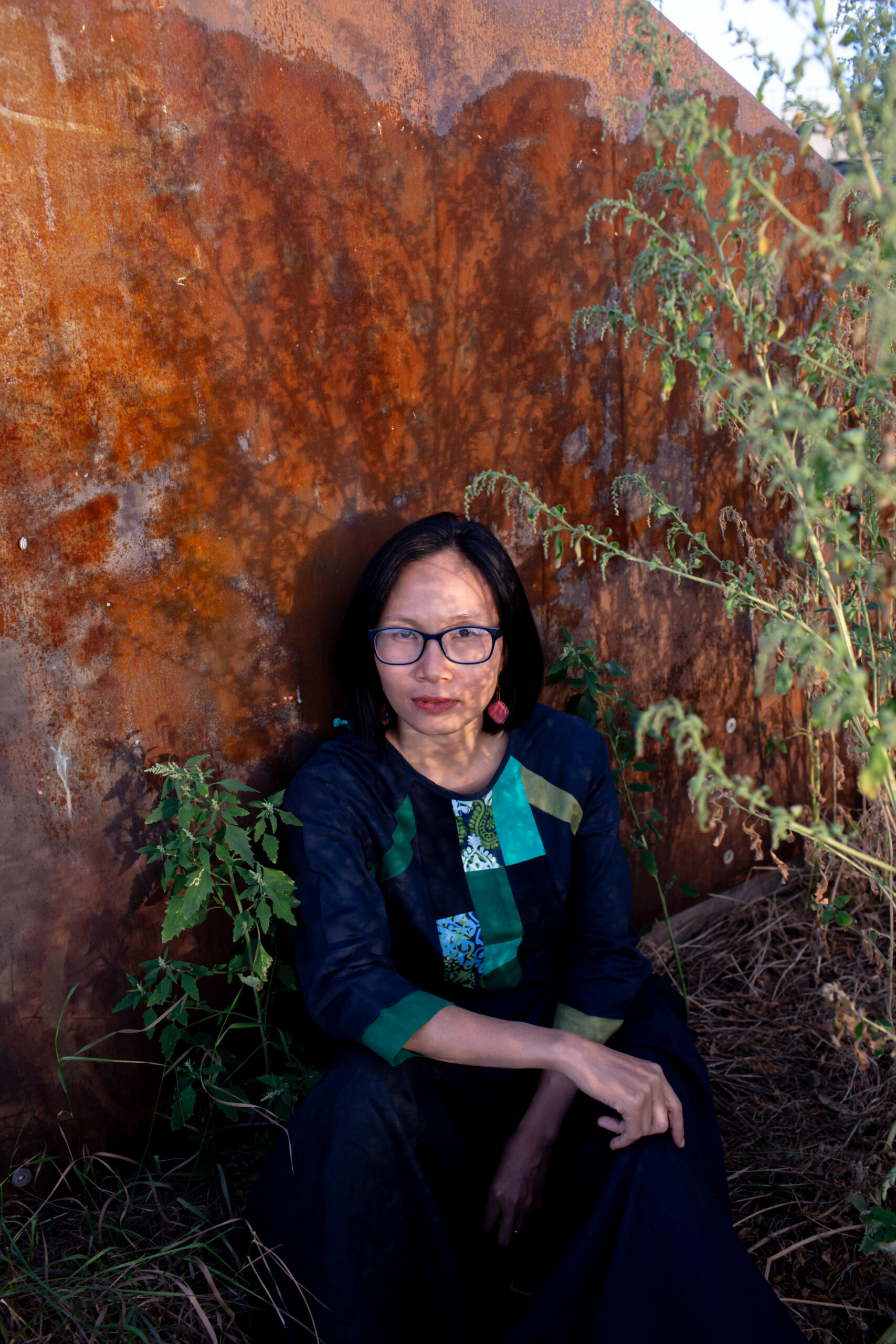
Photo by Yen Duong
giọt-giọt | shizukutachi will be presented from October 22–25 at KYOTO ART CENTER, as a collaboration between Zan Yamashita & Nhã Thuyên with Project Đẩy Sàn.
This project brings together artists working across three cities in Japan and Vietnam, weaving dialogue, poetry and dance notation into a book from which a stage work emerges.
For this project, we conducted an email interview with Nhã Thuyên,a Hanoi-based poet, author, and co-founder of independent publishing collective AJAR Press.
How did you first begin writing poetry? Could you also tell us about your activities as a poet today?
Everytime I am asked this question,“How did you first begin writing poetry?”I want to give a different answer. For many years, I have spent much of my time thinking about and thinking with the deceased, increasingly so in recent years, as so many loved ones have passed away. I frequently return to a scene from my childhood: my father sat there, in the middle of the large courtyard, beneath an immense grey sky, his small figure swaying with the autumn wind, a chill running across my skin, the entire late afternoon undulating in the white wreaths of incense smoke curling upwards. I watched freckles of ash fall onto the straw mat, covered with offerings for wandering souls, and listened to him chant Văn tế thập loại chúng sinh [Eulogy for ten categories of being], a poetic work by Nguyễn Du 阮攸 (1766–1820) that accompanies the rituals Vietnamese family perform every year on the Full Moon of the Seventh Lunar Month.
It dawns on me that perhaps this was partly how I came to poetry, and more specifically, to poetry for the dead, and how I cultivated the habit of reading words aloud. I sat quietly, listening to my father chant the eulogy, his head bent over the pages, his voice humming alongside the rhythmic beating of the wooden fish. During those afternoons of my childhood, I absorbed the forlorn air, I smelled the rain approaching from afar, or sensed its premonition carrying the breath of lost souls and hungry ghosts rising up from the mourning words.
Long gone past recurs: a little girl holding a chalk or a twig, wandering aimlessly by the door, by mother’s cabinet, scribbling her first marks, copying folk rhymes, and drawing the names of the familiar and the strange. In answering the question now, I hear a call to return to where everything began: my mother’s voice, the first ABCs of life, the first murmurings, the first words I learned to speak and the first lines I learned to write.
The activities of a poet today — or, more specifically, of me as a poet — have remained somehow unchanged over the years: I constantly relearn my language and my land, gleaning words from the surroundings, voicing and shaping my own words, to give them a life and let them be. Everyday, I continue to make a new mistake. Every day brings a new lesson. This process of learning is infinite.
There is nothing new or exciting in daily rhythm: work and obligations threaded through rare moments spent wholeheartedly with books and writing, a reminder to nurture a calmer heart, or at least to keep from falling into a worse version of myself. I lean on the resilience of living with and within language: holding on to my words, not allowing myself to drain away too quickly or stop halfway, and remaining engaged with a world that is somehow becoming more and more horrifying. A soliloquy from my heart: remember that the child is still there, tottering, learning to listen and to speak.
How was AJAR Press, of which you are a core member, established? We understand that Ajar Press is based in Hanoi and publishes journals as well as small-scale publications. Could you tell us what you value most in your activities?
This may be too long a story to tell here: my personal inventory of my twelve years with AJAR. It does feel like a dream — or an illusion of living poetically — that has become a significant part of my practice. AJAR was born from an encounter between Kaitlin Rees, who was living in Hà Nội and working in journalism at the time, and me, in 2014. It has since grown into an independent, experimental and multilingual poetry press: a collective space — though what does that word really mean?— based in Hà Nội, but literally nowhere, since our offices have moved between our homes and cafés around the city.
This dream of making books, and of making books as beautiful objects was realised in the spirit of being “ajar”: of being a door neither open nor shut, of creating a crack or an opening that questions its own openness. In Kaitlin’s words, that I would love to quote here, “AJAR from the beginning meant opening a space, even just a tiny crack at first, for breathing and play and imagining, a space not in reaction to or against, but in parallel to and at a distance from the narrow confines that were attempting to suffocate poets and poetry.” *1
When I started AJAR, I was idealistic enough to make things with bare hands, fuelled by a naïve belief that I could create a space where Vietnamese poetry might coexist equally with other languages — a narrow space in which readers, writers and books could stay outside, and resist ideological pressures while engaging in poetic exchanges. During those hyper-active days, with the unstinting support and care of friends and family, we made bilingual journals and poetry books, we organised workshops, hybrid readings and performances in cafés across the cities of Hà Nội and Sài Gòn, we showed our books at art-book fairs, and we created informal poetry festivals that brought together writers, poets, translators from Vietnam, Southeast Asia and beyond. We connected with friends. We made collaborative works. We made mistakes. And we burned out. Our ideas have been nurtured and have failed, risen and sunk over time.
AJAR grew quieter as our lives changed. Kaitlin returned to the United States, while our “floating” members literally floated elsewhere and took on other work. (For example, our super-active contributor Red, who had been involved with AJAR since her university days, relocated and later co-founded the amazing Project Đẩy Sàn.) As my life fluctuated, making books and organising community-based activities ceased to be my priority. In recent years, I have withdrawn into my own world, hoping to find a temporary equilibrium.
At the core of my work as a book maker, my hopes and questions for AJAR are inseparable from my hopes and questions for the Vietnamese language in its encounters with other languages: how to create a narrow but fruitful space for poets and poetic exchange. Situated within the broader condition of poetry publishing in Vietnam and elsewhere, this practice is deeply personal — a writer’s commitment to her mother tongue — but it exists only because it is collective, sustained by a shared vision and responsibility.
It has not been easy to sustain this unconventional mode of running a poetry press that is self-funded and entirely relies on collaboration and volunteer labours, and I am still learning from both its achievements and failures as I work toward transformation. I imagine a new beginning for AJAR, with new tasks, with expanded questions, and a little hope that remains, as it might come alive in a new form, one I hope to share more about in the future.
*1: ‘Human is a Half-Open Being’: An Interview with AJAR Press – Dao Strom in conversation with Kaitlin Rees and Nhã Thuyên. Published on 12 July, 2020. Link accessed at: https://diacritics.org/2020/07/human-is-a-half-open-being-an-interview-with-ajar-press/
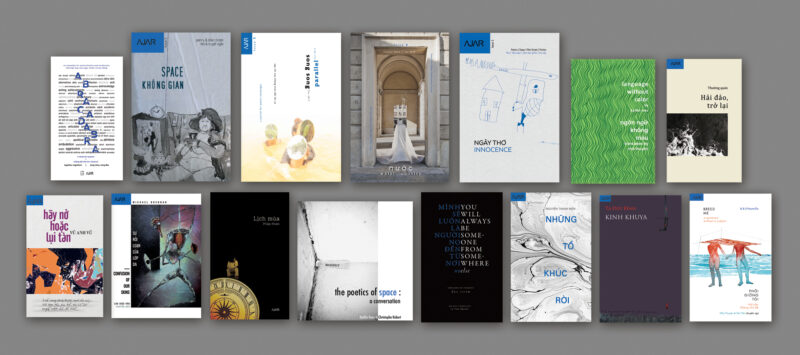
a part of AJAR book catalogue
In your conversation with Zan-san, we were particularly struck by your thoughts on the complexity and beauty of the Vietnamese language. What do you find most compelling about Vietnamese? And how does the language influence your creative practice?
When I write in Vietnamese language, I always return to the question of tiếng, a word that resists English translation, or rather, resists any single, definitive translation and demands multiple interpretations.
Tiếng has a sound.
Tiếng has a voice.
Tiếng has an accent.
Tiếng has a call.
Tiếng has a name.
Tiếng has a language.
With tiếng, I imagine a palimpsest of daytime language and night-time language on my page, whether in my mother tongue or in the languages of translation — by others and by myself. I quote here some lines from my poetry, which also appear in the book giọt-giọt |しずくたち.
“my daytime language is articulate and lifeless, i mutter some drowsy words on a drowsy subject, diligently crush the eggs of the spasmodic species of fish, the surviving words cripple, their scars fester, their scars reincarnate scars, live another life of cruel scar, how does a scar cry,
“my nighttime language is pitch-black and brutal, stars no longer roam, no longer play peekaboo, all stops, but we have seen the mirror of each other and all of you stirs me, the wind stirs the sea, the salt stings, the tongues of briny waves bite against sedimentary rock holding silent in the story that does not need an ending, no one returns to continue the unfinished conversation, i pack the abandoned days and months to preserve the memory from that moment, when the rain came and the child called out, you complaining about me keeping all the books you love and me continuing to ask for the pen you insist on having already given back, the book’s traces pale from page to page, the sounds of a night, the sounds of a day, how does a sound cry, ”
(Nhã Thuyên, don’t hide the madness, English translation by Kaitlin Rees)
In Kaitlin Rees’s English translation, the original Vietnamese phrase “tiếng kêu thế nào?” becomes “how does a sound cry” — a choice, among several others, that emphasises the raw, physical vibration contained in the word “tiếng”. Tiếng is perhaps the ‘primordial material’ of my poetics. Tiếng utters the sound of flesh, skin, and spirit. Tiếng reveals where you come from. Tiếng calls you to drift far away and wind back to your hometown. Tiếng confirms that you are not muted, that your language is heard. “how does a language/ an utterance/ a call/ a voice cry?”
Thinking of tiếng as my primodial material, I keep asking how I might push the materiality of words to its limit, through their sounds, shapes and meanings. How can I make language tangible: to see visible sounds, to hear the appearance of text, a visible poetic text that is sound-able. This is the initial impulse behind my sound-text poems, the impulse of a poet relearning their language by speaking its prelinguistic sounds.
For this collaboration with Zan-san, you created a book in Vietnam ahead of the performance. As a key member of the project, you were involved in its production through poetry writing, editing, and other aspects. Could you tell us about the process of making the book?
I’d love to tell a long, rambling story about how the book came together. To me, this is an unexpected gift along the journey of writing: one coffee leads to a book and a theatre performance.
I first met Zan-san during his research trip to Sài Gòn, which coincided with my visit to present my PhD research in progress at the Practice Research Symposium Asia in March 2026. We had only a couple of hours for coffee before I had to head to the airport to return to Hà Nội. The meeting was arranged by my friend Red at the Project Đẩy Sàn, to see if there is a possible collaboration. In a hidden old apartment-café, a specialty of the town, Zan-san told me about his trip, his dance workshop with local artists, his interest in books, and his plan to make a book for his commissioned performance. He had looked through the website of AJAR, and asked me about book making. Drained after the symposium, I felt somewhat lost. I talked about what I had been doing and having a long pause with AJAR, and about my desire to make an artist’s book that could be imagined as an exhibition, with space, sounds and visuals in the text: a book of sound-text, in which letters and their sounds could be heard. I also explained that, as I am not a performance artist, I had not thought of a book specifically designed for performance on a theatre stage. Yet I am interested in theatre, and in the performative potential of a book: a book that performs its own language, a book as a performance of text. I had not had time to read about and watch Zan’s work before we met, and at a certain point, I was simply floating with my own ideas.
Zan-san then suggested that he would do some improvised dances and asked me to write in his notebook while watching him dance. We asked the café’s staff whether we could use part of the quiet room, and she agreed, since there were no other guests at the time — a couple arrived while he was dancing though. I watched him improvise. His body seemed both still and in motion, his face remained like a calm lake. I fantasized a quiet breeze moving between branches, echoed in the movement of his hands and, especially, of his toes as they inched across the narrow space. There is a micro-poetics in the movement of his body that resonated with my aesthetic concern. But after the meeting, I left the experience and my thoughts there, unsure what we might do if we decided to collaborate.
A couple of weeks later, Zan-san and Kyoto Experiment’s (KEX) organizing team contacted me to arrange an online meeting, and then another trip for Zan to Hà Nội. The purpose was, “to get to know each other” and to talk further about the possibility of making a book that would become part of his theatre work. We met in early July, this time with a Japanese interpreter and Ngân, an AJAR friend. We officially said “yes” to collaborate — although we still did not know exactly what the collaboration would look like, and the rest of working time was mostly about the project’s logistics and some initial ideas of papers and forms.
What we agreed on during this working weekend was a concept and a title for the collaboration, in both Japanese and Vietnamese. At that point, however, nothing concrete had yet taken shape. I talked about a poetic sequence that I had been sketching in my mind, provisionally titled Thủy âm — a title I later translated as Aquatic utterances and rendered in kanji as 水 言. This idea combines the Sino-Vietnamese word thủy, which can be 水 [water] and 始 [original source], and âm, which means “sound”, “vowel”, and as an alternative for tiếng, it also means “language” — a combination continues my obsession with tracing back to the beginning of language and the impossibility of the task. Zan-san came up with [しずくたち] (shizukutachi), with a play of making it in plural, meaning “a collective of drops” in Japanese. The connection with water was simply a pure coincidence. There are already so many drops dripping through my poetry, I thought to myself. I then invented a Vietnamese title, giọt-giọt, that visualises giọt, a droplet of fluid, as a poetic object. In Vietnamese, repeating giọt-giọt suggests abundance, sound and movement. Before parting, we also took turns interviewing each other, about one hour each, in order to learn more about each other’s work. I thought the interviews might become part of the future book, (but they did not!).
Later, as the editorial lead of the performance-book, I set myself a new challenge: to make a book in which poetry and experimental dance theater can converse, both on page and on stage. I continue to imagine poetry as a living body of sounds, letters and words that can breathe and dance on the page, then be embodied in physical space. We need to make a book that is not merely meant to be read but is itself a performance of text: a work that can be acted upon. I then take tiếng, with all possible dimensions of the word—both as an abstract concept and as the concrete materiality of language — as the crux of this poetic, text-based book.
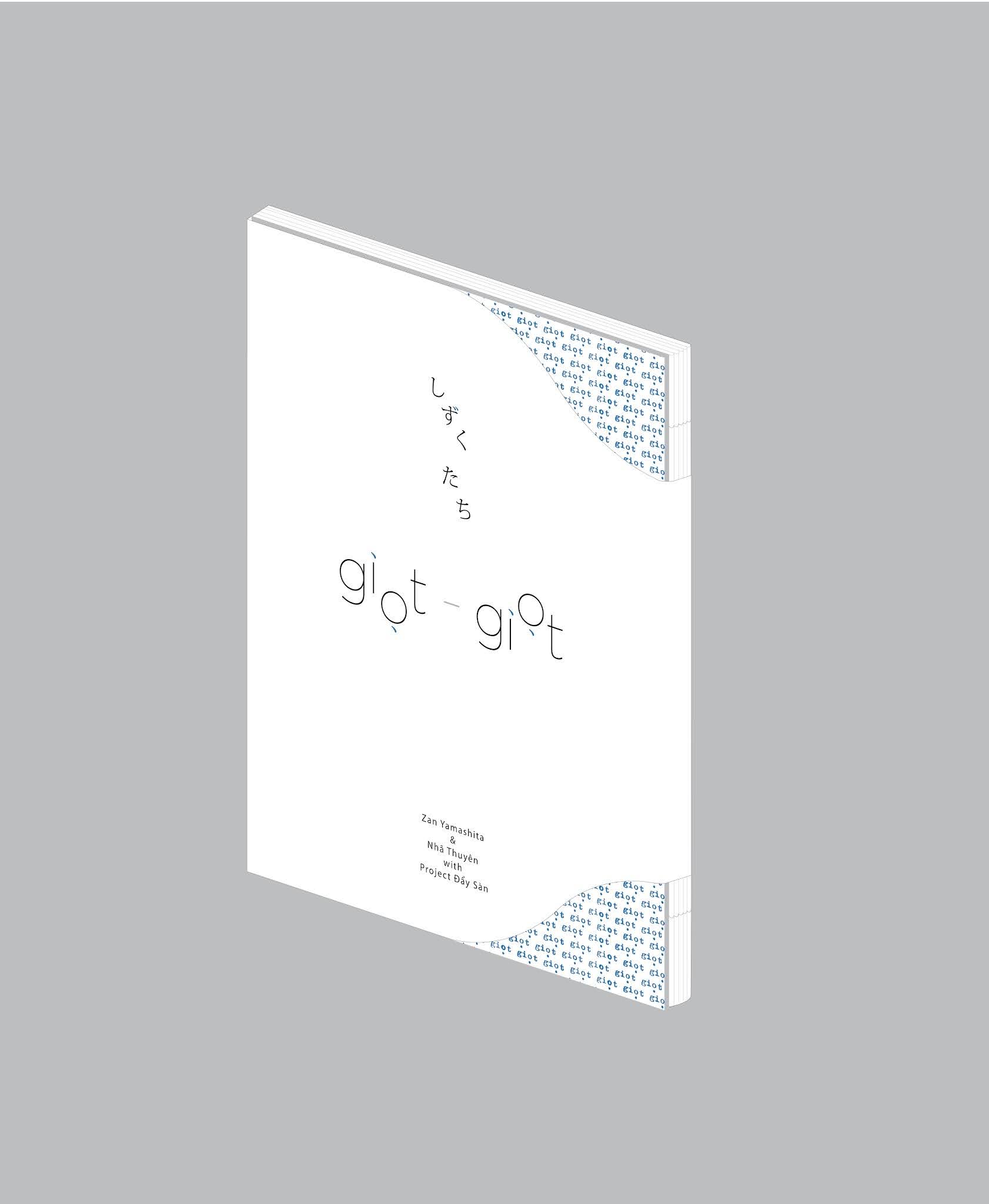
As I answer this email interview, the first phase of my collaboration with Zan-san and Project Đẩy Sàn has borne fruit: the book is finally in our hands! My poetry, which forms the main text of the book, includes a series of new typewritten and bilingual poems, as well as several older poems taken from my long-abandoned manuscript vị nước [taste of water]. Conceptually, I have structured giọt-giọt |しずくたち in three sections, echoing key phonetic components of a Vietnamese syllable: the initial sounds, the nuclear vowels and the coda, shaped by the movement between rising and falling tones. Alongside my poetry, sketches and typewritten works, the book contains two other sections: dance notations resulting from the experimentation sessions Zan-san conducted with Vietnamese artists in Sài Gòn in July 2026 (I did not participate in this workshop); and a recovered text from the distant past — a personal treasure and a memory of the dead: an excerpt from a novella 北を守る子供たち [Children defending the North] written by Yoshiyuki Yamashita, Zan-san’s grandfather, and published by Tofu Shobo in 1942 in Mukden, Manchukuo.
I should be clear: I had been incubating my sound-text poems for quite some time, without knowing that they would become part of my collaboration with Zan-san. (How the typewritten poems have been born could be another part of this book-making story. And another story: when I began working with Zan-san, I did not imagine that our collaboration would contribute to the progress of my practice-led research.) Fortunately, the collaboration resonates with my exploration into materiality of utterances and micro-structure of language, with concepts moving between forms, disciplines, languages and cultures. It also reflects my concern with how experimental art and poetry can make sense — and make us sensed, both individually and collectively, in a world dominated by media consumption and ongoing violence. I would not discuss the performance here yet — it will take place in October, and much about it remains unknown to me.
The whole process of working day and night over the summer to realise this publication has been a genuine collaboration and fruitful transformation. I acknowledge the coincidence of ideas; countless hours spent working over coffee with our incredible AJAR humans and the Project Đẩy Sàn team—specially Ngân, Thanh San, and Red; and with Zan-san’s weekend flight to Hà Nội, in the height of summer, to sit with us, share some noise and laughters, and meticulously check options of papers, word-arrangements and images. We are infinitely grateful to the local artists who contributed their dance notations from the workshop with Zan-san, and to the amazing translators who worked so hard to meet a strict deadline and make the text bloom in three languages: Vietnamese, English and Japanese, and to our supportive printer who carried out so many printing tests. We thankfully acknowledge the wonderful support of the KEX team and the Japan Foundation, without which this book could not have been realised. And there is my quiet thank you to the coffee mugs, the cafés that became our temporary offices around town, my almost-abandoned typewriter, the paper, the words, the dictionary, and the support from friends and family during those intense months of work. This book is indeed a collective: a bunch of drops falling into the unknown, (hand)bound by a shared engagement with beauty and languages.
Now we wait for another not-yet-known process: the performance.
As you begin developing the performance in Kyoto, what are you looking forward to, and what are your hopes or aspirations for the process?
Being a part of the performance in Kyoto means embracing the not-yet-known. I envision it as a process of experimentation: exploring how the tangibility of language, in its various forms, can be brought to the stage, how poetic sounds and layers of voices can be embodied, and how the language of movement can be sensed across different environments over the course of five sessions. And I look forward to co-listening, co-watching, co-reading and co-sensing these languages with audiences as active participants.
I’ll walk through the streets of Kyoto and see the Kamogawa River for the first time. I cherish this special gift of encounter: the opportunity to learn about cities, their lands and their people always nourishes my practice.
Nhã Thuyên – 26 September 2026
Nhã Thuyên
Hanoi, Vietnam
Nhã Thuyên is a poet, writer, and editor based in Hà Nội, Việt Nam. For over two decades, her practice has primarily dwelled in writing and making books, while extending to public readings, performances and collaborative poetic exchanges. She has authored several books in Vietnamese and in English translation, including từ thở, những người lạ (words breathe, creatures of elsewhere) (2015), bất\ \tuẫn: những hiện diện [tự-] vắng trong thơ Việt (un\ \martyred: [self-]vanishing presences in Vietnamese poetry) (2019) and đừng giấu cơn điên (don’t hide the madness) (2024). In 2014, she co-founded AJAR, a micro bilingual journal-press — an online and print poetic space with occasional small gatherings. Her work has appeared in venues such as Asymptote, Cordite Poetry Review, The Margins, Words Without Borders, Jacket2, Gulf Coast, The Kenyon Review and Modern Poetry in Translation. Her poems have been translated into English, German and Dutch, and performed in various cafés, art spaces and at international festivals in the Asia-Pacific, the UK and across Europe. She is a recipient of honours including the 2022 Rotterdam Poetry International and the 2023 DAAD Artists-in-Berlin fellowship. Currently, she is engaged in practice-based research at RMIT University, while her next poetry collection, vị nước (taste of water), waits to see the moon.